Culture

  • Whitney Biennial

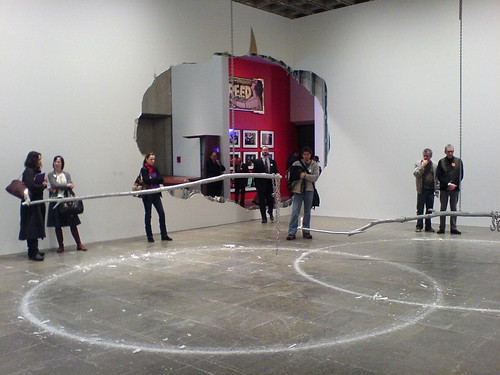
    Urs Fischer installation view, with Kenneth Anger's room visible in the background (Whitney Biennial)

    Urs Fischer installation view, with Kenneth Anger’s room visible in the background

    James and I attended the press preview yesterday. I expect to write more, and put up some more photos, but I wanted to post some random initial impressions. Also, I can’t use my catalog for reference yet since the cover fell off when I opened it and the pages haven’t all been cut (oops those are fold-outs).

    My first impression is that there are a lot more artists with whom I was unfamiliar, unlike the previous one. I’m pleased to see that, because I don’t want the Biennial to show a lot of work that regular New York-based gallery-goers have already seen.

    A number of works (such as those of Jutta Koether) were created in the spaces, with the curators indicating that the artists’ responses to the Breuer building were an important part of this Biennial.

    I was struck by the mention of the curators visiting Berlin to see works by young American artists. I worry very much about New York’s ability to remain a cultural capital when it’s so hard for artists to afford to live here. This week-old article from Crain’s New York on the subject gives some statistics from a study by the Freelancers Union.

    There is a great deal of political work in the show, which is fine by me, as well has heavily conceptual work. Joao Ribas has an interview on Artinfo with the curators in which they discuss the number of “anonymous” or “fictional” artists/collectives in the show. I would also say the spirit of Beuys is apparent in the show with works by Urs Fischer, JP Munro, and others.

    One more observation: I found it odd that a number of works dealing with African-American issues and politics were all put together — including works by Dawolu Jabari Anderson, Robert A. Pruitt, and Otabenga Jones & Associates. I didn’t see a specific mention of a conscious choice to put these near (or next to) each other in any wall texts, but I can think of few other obvious groupings of work dealing with “identity politics” in the show.

    ·

    Categories:
  • Midtown highlights

    James and I ventured up to midtown on Tuesday to see several shows. The highlights:

    pablo-bronstein-theatre.jpg

    Pablo Bronstein, Theatre, 2005, ink, gouache/paper, 16” by 18” [image from gallery website]

    I Love My Scene: Scene 1, curated by Jose Freire of Team Gallery at Mary Boone. I’m happy to see the gallery pulling in some interesting outside curators to do shows. It’s an intriguing mix including photography (Weegee and Cecil Beaton), sculpture (Keith Sonnier, Lothar Hempel, and Banks Violette), and drawing by Pablo Bronstein. I hadn’t heard of him before, but his work appears to be drawings for fantastic stage sets. Google tells me that Saatchi owns some works by him.

    William Kentridge at Marian Goodman

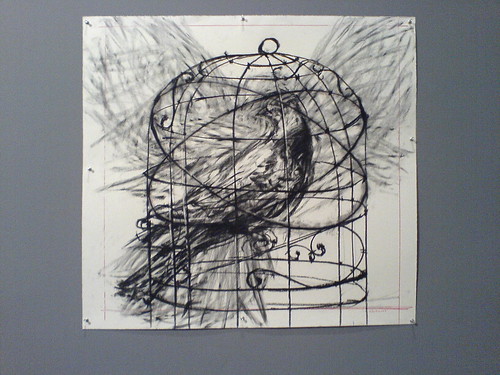
    William Kentridge’s drawings and designs for a production of Mozart’s Magic Flute at Marian Goodman were, pardon the expression, enchanting.

    Eija-Liisa Ahtila at Marian Goodman

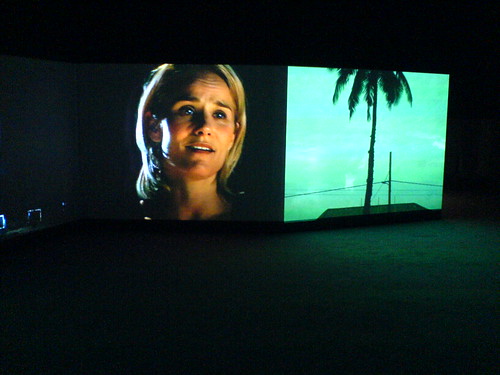
    Eija-Liisa Ahtila’s 4-screen work The Hour of Prayer was a nice discovery in the back at Marian Goodman after visiting the Kentridge show. There are more images of both Kentridge and Ahtila’s work in my NYC Art 2006 set on Flickr.

    Tim Davis White Tiger

    Tim Davis, White Tiger, 2005, c-print, 35” × 44” [image from gallery website]

    I love everything Tim Davis does, and this show at Greenberg Van Doren is no exception. In some ways it is like Roe Ethridge’s last show at Andrew Kreps — it feels like a set of images the artist just likes. If you’re a photographer like one of those, that’s good enough for me.

    ·

    Categories:
  • Charlie Finch / Artnet

    I don’t think I can think of anything to add to the good blogosphere writing on the subject of Finch’s horrifying attitude towards women. Edna at Anonymous Female Artist is a good source for updates on the subject.

    ·

    Categories:
  • Biltmore Syndrome

    Via Culturebot I found this great slapdown by David Cote in Time Out New York of mediocre, safe uptown theater. More reviews should be like this. Anthony Tommasini can be counted on to write similar, yet more polite, things about how bad classical music institutions are these days.

    David Lindsay-Abaire’s Rabbit Hole made me sick. During this competent dramedy about the mourning process, I experienced bizarre hallucinations, nausea, confusion and an irritability verging on dyspepsia. Upon learning my theater-going patterns, the doctor delivered a swift diagnosis of Biltmore Syndrome. It’s a fairly common condition brought about by seeing too many middlebrow, bourgeois plays at New York’s big nonprofit theaters. The disease gets its name, obviously, from MTC’s Biltmore Theatre, which has been home to a steady stream of unimaginative comedies and dramas about middle-class angst since it opened in 2003.

    No doubt there’s a thrilling play to be written about grief and recovery in suburbia, but this isn’t it. And until Lindsay-Abaire and his supporters at MTC crack the code, you’ll learn more from Oprah and Dr. Phil than from this pabulum. Personally, I’d rather see a ripping tale about Uzi-wielding hobos spreading grief around than brave homeowners suppressing it.

    But then, I’m not an MTC subscriber or ticket buyer; I don’t have to justify seeing money wasted on an expensive-looking set and the blandest stars that money can buy. John Lee Beatty’s lavish Westchester interiors, spinning on hydraulic turntables, stand as smug, imagination-murdering monuments to MTC’s wealth and, presumably, the well-appointed estates of some percentage of its subscribers. And, like its aesthetic clones, the Roundabout Theatre Company and Lincoln Center Theater, MTC attracts big names regardless of whether they possess real talent.

    ·

    Categories:
  • Contemporary Artists Meet Himalayan Art at the Rubin Museum in Chelsea

    rubin museum logo

    Andrew Maerkle is curating a series of (free!) informal talks and tours of the MuseumÂ’s galleries on Friday evenings from February 3 to May 29, sponsored by Art Asia Pacific Magazine.

    Tonight’s talk is by Hiroshi Sunairi.

    ·

    Categories:
  • Amy Grant + Stefan Tcherepnin at Oliver Kamm/5BE Gallery

    Amy Granat

    I’m trying out a new feature on my cell phone — video with sound!

    Windows people should be able to play it with Quicktime or RealPlayer, and Mac users with Quicktime. Warning: it’s loud!

    The video is of one of the “scratch film” works in the show, and the sound is by Stefan Tcherepnin, the latest member of that great musical family.

    Download 136K 3GPP movie

    ·

    Categories:
  • Art New York cancelled

    I’m not sure if I had even heard of this. The Crain’s story has a rather interesting headline:

    Cancelled art fair a sign of saturated market

    by Miriam Kreinin Souccar

    Organizers have pulled the plug on a new art fair that was scheduled for Manhattan later this month, a sign that the market may be saturated.

    Art New York at Pier 94 was supposed to bring together around 150 contemporary art galleries from around the world to the space at 12th Avenue and 54th Street. Created by Thomas Blackman Associates, producer of major art fairs including Art Chicago, the fair was to run Feb. 24-27. It was timed to coincide with the long-running prestigious show of the Art Dealers Association of America, which opens Feb. 23.

    I love this part too. Does anyone else know a huge number of un-represented artists?

    Art dealers say they donÂ’t have enough good work to bring to all of the fairs and that artists simply canÂ’t create on such a fast timetable.

    Updated

    Check out Sean Bonner’s thoughts on the subject of art fair dysfunction.

    ·

    Categories:
  • Jeremy Wade and Dance Theater Workshop

    jeremy wade at dtw

    Jeremy Wade

    Last night we went to a great dance performance by Jeremy Wade. Not only was his choreography and dancing amazing, so were his collaborators:

    • Jessica Hill as his dance partner in the first piece, Glory
    • Music by Michael Mahalchick and Loren Kiyoshi Dempster for Glory
    • Music by Mike Skinner (and Jeremy Wade) for Fiction
    • Lighting by Jonathan Belcher

    Jeremy Wade did the costumes as well.

    His choreography uses dancers’ faces in a way I have never seen before. I also appreciated the mix of… how to put this… movements reminiscient of a child, or a person without full muscle control. I can’t get his child-like gestures of joy out of my mind. Interestingly, in the duet Jessica Hill’s movements were a mix of those plus more conventionally dance-like moves. She was almost doing a pop and lock during parts of the early section.

    There are two more nights — Friday (tonight) and Saturday — both at 7:30pm. Go! He is a definitely a distinctive voice in NYC dance.

    Tickets information is here.

    [photo from the DTW website]

    ·

    Categories:
  • Little Red Schoolhouse art benefit

    littleredschoolhouse.jpg

    I’ve updated my list of favorite art benefits to add the Little Red Schoolhouse benefit on February 2nd. The list of artists is amazing, including some alumni such as Nayland Blake.

    ·

    Categories:
  • You may see this quote again

    blake-angel-of-the-revelation.jpg

    The Angel of the Revelation, ca.1803–5
    William Blake (British, 1757–1827)
    Watercolor, brush and gray wash, pen and black ink over graphite on paper; 15 7/16 × 10 1/4 in.

    You may see this quote, attributed to William Blake, again when we curate a show in the fall at Dam, Stuhltrager.

    You never know what is enough unless you know what is more than enough.

    [image from the Metropolitan Museum of Art

    ·

    Categories: