All decent people should run away from home. — Fritz Lang, 1975
I heard this quote in a fascinating interview with Fritz Lang by William Friedkin last night, from the bonus disc to The Criterion Collection’s excellent release of “M.”
All decent people should run away from home. — Fritz Lang, 1975
I heard this quote in a fascinating interview with Fritz Lang by William Friedkin last night, from the bonus disc to The Criterion Collection’s excellent release of “M.”
·
Gentrification pushing out artists has a long history in New York. Via the New York Times:

A 1921 cartoon, courtesy of Duke University, shows a displaced artist walking past Vincent Pepe, an Italian-born real estate entrepreneur, and two rich clients in search of a Village home.
Apparently, I’m quite behind for just now hearing about this. I’m impressed that Ukraine’s Got Talent would have a performer who does Robin Rhode/William Kentridge-esque animation with sand about the Nazi invasion of her country.
Update: There is a FAQ for the video! Thanks, Marc Shifflett.

Shostakovich on the cover of Time, 1942, via Zeitschichten
William T. Vollmann’s historical novel Europe Central is at times a long, dark slog, but definitely worth the effort. His research into Nazi and Soviet history is impressive, particularly on musical topics — don’t miss the notes at the end. What other contemporary novel is likely to spend so much time with not only Dmitri Shostakovich, but less-famous composers such as Moisey Vainberg and Galina Ustvolskaya?
The only thing I disliked about the book was when the chapters about Shostakovich imitated the verbal tics he developed as he got older, due to the extreme mental stress he suffered under the Soviets. One example, from the “Opus 110” section of the book, when he is talking with NKVD men about his work, is below:
Because my hands get tired, comrades, even when I … It, so to speak, subverts me. But I’m only a worm, and my symphonies are mere, uh, so it’s no loss to, to … I do apologize.
I understand the importance of conveying how he communicated later in his life, and a letter by Isaiah Berlin about his sad visit to Oxford in 1958 certainly documents that, but it’s painful to read one hundred consecutive pages written in that style.
The long passages about the harrowing conditions for Soviet and Nazi soldiers on the Eastern Front, civilians in Leningrad, Dresden, and 1944-45 Berlin, as well as chapters set in East Germany after the war, serve as a strong antidote to the ridiculous idea that the USA saved Europe single-handedly in World War II. The Soviets and the countries of Eastern Europe lost millions of people — soldiers and civilians — as the West allowed them to grind down much of the strength of Nazi Germany. The people of central Europe were then abandoned to the sinister realities of Stalinism once victory was declared.
The novel is overlong, and could have used some more editing, but its empathy for the people of Europe Central is a worthy accompaniment to the works of Anna Akhmatova and Shostakovich regarding this dark period of our “civilized” 20th century.
·

James says it better than I can, as usual. Today marks the launch of our new publishing venture, Idiom.
Its mission statement:
Idiom is an online publication of urban artistic practice. By allowing emerging artists, writers and arts professionals to report on, review, and otherwise cover overlooked or under-thought aspects of the larger creative community, Idiom offers a local, engaged counterpoint to the prevailing discourse of contemporary art.
Thanks to the NY Times I learned of Here is Where whose mission is
to find and spotlight little known and unmarked historic sites throughout the United States.
I really love this story from the article:
The Marriott Wardman Park Hotel in Washington, Mr. Carroll’s hometown, has agreed to install a marker that commemorates a moment on Nov. 27, 1925, when the poet Vachel Lindsay was timidly approached at dinner by a busboy who placed three poems he had written next to Lindsay’s plate. Lindsay was so impressed that he shared them with his audience at a poetry reading that night, prompting journalists to report on the “busboy poet.” His name was Langston Hughes.
·
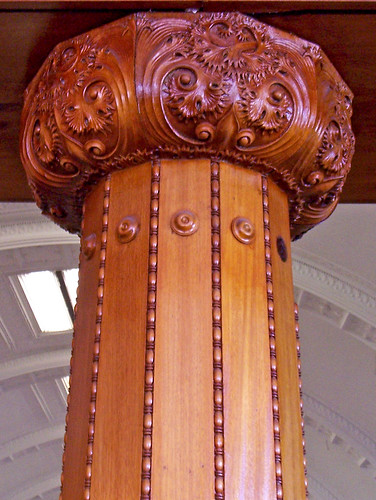
Carved ornamental wooden capital in the Auditorium Building, 430 South Michigan Avenue in Chicago, Illinois. Adler & Sullivan, architects. Via Atelier Teee on flickr.
James and I headed to Chicago for a few days on an art and architecture vacation. We’re also seeing the Chicago Opera Vanguard’s production of “Greek” by Mark-Anthony Turnage. We’re meeting people for drinks on the 4th. E-mail for details if you would like to join us.

The Civilians are holding their annual performance and benefit party on Friday, April 17th at Galapagos DUMBO. Their current projects include an investigation of the monstrous Atlantic Yards development in Brooklyn and its effects on the surrounding communities.
Please join us at the newly reopened Galapagos Art Space in DUMBO for a one-night-only performance created from your stories. After a season spent investigating community in Brooklyn and Colorado Springs, we turn our attention to you and invite you to participate in an original Civilians piece by sharing personal insights about what HOME means to you.
They also have a silent auction page up for bidding. Items include theater memberships and a print by Mixed Greens artist Coke Wisdom O’Neal.
·

Large poster of Hindenburg during the first ballot of the Reich presidential election, March 13, 1932
I am really enjoying looking through the images provided by the German Federal Archives to Wikimedia Commons. Look at that building! We can barely get anything that modern in New York in 2009!
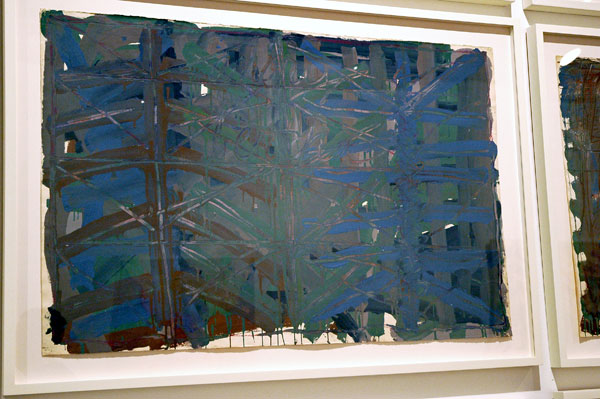
Louise Fishman, Angry Bertha, 1973, acrylic on paper, 26.5 × 40.25 inches
Next weekend, the Chelsea Symphony (we think they’re awesome) is honoring artist Louise Fishman for her 70th birthday. The program includes a new work by Aaron Dai based on a text by poet and former presidential candidate Eileen Myles inspired by Louise’s “Angry Paintings”.
[photo by James Wagner