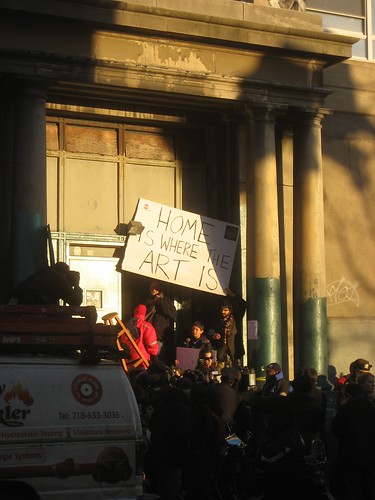
Develop Don’t Destroy is encouraging people to show up at the Brooklyn Museum on Thursday, April 3rd, 6:30-8:30pm to protest the museum’s choice of honoree for its annual fund raiser: developer Bruce Ratner. He is the developer of the infamous Atlantic Yards project, which has resulted in the use of eminent domain on behalf of a private entity to displace a huge number of people and tear down historic structures such as the Ward Bread Bakery building. Note that the New York Times is now reporting that, despite the billions of subsidies promised so far, the project might be scaled back due to the shrinking bond and credit markets. That won’t bring back any buildings or help the people and businesses that have already been forced to move.
If you’re interested in some very detailed information on the project and Mr. Ratner, I have pasted below a copy of an open letter from attorney Michael D. D. White that I received via Chuck Yuen and Meredith Allen. This is my favorite paragraph:
Ratner should not be confused with an erstwhile robber baron who did ill a long time ago and is now dispensing funds after the fact to atone and get into heaven. Ratner is doing his damage to the community now and this “honor” from the Museum is a mechanism to further damage the community.
[Note: the comments have been closed on this post due to spammers loving it for some reason.]
—
March 31, 2008
Board of Trustees
Brooklyn Museum
200 Eastern Parkway
Brooklyn, New York 11238-6052
Re: Inappropriateness of the Brooklyn Museum’s “Honoring” Bruce Ratner
Dear Brooklyn Museum Board of Trustees:
I write this as an open letter to the Brooklyn Museum.
My wife and I came home on Wednesday, March 12th, opened our mail from the Brooklyn Museum, an institution important to us, and were dumbfounded and aghast to discover that we were being invited to a Brooklyn Museum Ball “honoring Bruce Ratner.”
It is uncomfortable to step up and point out why it is inappropriate for the Museum to be “honoring” Ratner, but it is crucial. If it helps that I am not only a longtime Museum supporter but also a lawyer, an urban planner and have had a long career in government with the State Finance authorities, then it is probably all the more incumbent upon me to speak.
I do not believe it is appropriate for a respected public institution like the Brooklyn Museum to be honoring Bruce Ratner. To many of us this is obvious but I will explain the many reasons why.
A museum should be a good neighbor to its community. You cannot be a good neighbor by promoting the activities of someone who is a bad neighbor, and worse, to the community.
Where I come from in government, garnering public subsidy via influence and sidestepping a proper bid process can wind up with the perpetrators going to prison. Using influence and sidestepping a proper bid process is exactly the way that Bruce Ratner is proposing to develop the Atlantic Yards megadevelopment. As a lawyer, I could almost certainly make a distinction between what Mr. Ratner is doing and what sends people to jail but it would be so technical I am not sure most people would understand or regard it as important. And I am not sure if there would be an accompanying moral distinction. Nor could I assure you that, if the facts were fully known about Mr. Ratner’s influence and access, that there would be a legal distinction. I leave it for the people who want a special distinct status to set Bruce Ratner apart to explain what and why that should be. I will point out the main appreciable difference: Ratner’s proposed no-bid subsidy grabbing is on a sheer magnitude of scale that is incomparable. The proposed no-bid subsidies Ratner intends to collect from the public are easily in excess of $2-2.5 billion. That far exceeds anything I am familiar with in other analogous situations.
Why would the Brooklyn Museum “honor” Bruce Ratner at this time? There is no equation whereby this is a good time, from the Museum’s standpoint, to honor Ratner. Ratner has an extremely unpopular and massively controversial proposed megadevelopment in the offing. Approval of just the arena is about 50% positive and 50% negative in the borough. The overall project has much higher and rising negatives; when dealing with an informed population or a population like the membership of the Museum itself the negative view must be 85-90% or higher. (In a recent letter to the editor on this subject, one Park Slope resident points out that the Museum heretofore has actually followed a policy of regulating Museum public events to avoid political controversy by denying its facilities to events that were deemed “too political” or “too controversial.”) No, this was not a good time from the Museum’s standpoint to “honor” Ratner. There were plenty of worthy individuals the Museum could properly have decided to honor instead.
From Ratner’s point of view, was this a good time to be “honored” by the Brooklyn Museum? Ratner is desperately in need of multiple public approvals for his Brooklyn project, the largest project in the city by a single developer. Without these approvals the project cannot proceed. Crain’s New York gives the project no better than a 50% chance of succeeding. Other far more dire predications abound for the megadevelopment’s fate. Ratner desires to relinquish none of the billions in subsidies he is pursuing. The City Council and State might take some back; that is being talked about. So, yes, there is every reason it was good from Ratner’s standpoint to be honored by the Museum- for the sake of promoting the megaproject.
Terrible time for the Museum; excellent time for Ratner- From this we may infer that the decision to honor Ratner was not driven by the careful considered judgment of those Museum board members with the best interest of the Museum at heart, but rather by those on the board with business connections to Ratner exerting influence. (For identification of some of these conflicts of interest I refer you to the coverage of Atlantic Yards Report. see: http://www.atlanticyardsreport.com/2008/03/at-brooklyn-museum-gala-honors-for-and.html.) This concession to Ratner’s influence hurts the Museum substantially.
Mutual acquaintances tell me that there can be a certain irascible charm to Mr. Ratner’s irrepressibility. But the issue is not his social skills at a soiree or on the golf course. Nor is it a question of what, upon inquiry, one would discover about what people say the experience of working for him is like. The question, from the Museum’s standpoint, is the man’s public life and what in that public life might be the subject of honor or dishonor- to use the Museum’s words, a proper evaluation of Bruce C. Ratner as a “corporate citizen of Brooklyn and greater New York City.”
It is fair to assess Mr. Ratner on this, particularly since I believe that Mr. Ratner appears to have solicited this honor and the process of awarding it to him no doubt requires that Ratner is willing to publicly put himself forward to accept it.
In the arena of public events, Bruce Ratner is behaving antisocially, hostile to the community and in a manner adverse to Brooklyn in the ways listed below. When it comes to Brooklyn, I am not aware of any counterbalancing good things weighing equally on the positive side.
a. Megadevelopment Designed as No-bid Subsidy Hog. Even setting aside the distracting mannerisms of Frank Gehry, the pop architect responsible for “designing” Atlantic Yards, it is immediately obvious from any kind of rendering that shows the mass and density of Atlantic Yards that the megadevelopment is a palpably poor match for the community of which it is supposed to be a part. This highlights how Ratner intends to use his no-bid jump to the front of the subsidy line. He does not propose to build the best project possible for the area or even to build a good one that fits in well. He proposes only to build a project that will soak up as much public subsidy on a no-bid basis as possible. The beyond-any-limit, unprecedentedly dense project is not designed to weave into its community or serve the public: (It is startlingly different from the new 10-story Atlantic Terrace project across the street which represents the vision of all the same government officials for what belongs in the area. – Atlantic Yards is so much taller than this 10-story project that its shadow will prevent Atlantic Terrace from using solar panels as originally planned.). The huge increase in density Ratner is proposing to garner through a zoning override, sidestepping procedures and public review represents, in and of itself, an incredible subsidy. This `density subsidy’ is then multiplied by all the other subsidies the project is designed to sponge up. Pursuit of this “density subsidy” and the resulting multiplication by other subsidies is also what makes closing down neighborhood streets and avenues attractive to Ratner though it constitutes a significant negative result for the community. The misdirection of these subsidies is at the expense of other developers to whom these subsidies should be rightfully flowing and whose market will be impinged upon with unfair competition. Over half the escalating cost of the $4.4 billion Ratner megadevelopment will be paid for with these hogged public subsidies.
b. Arena as Device to Bloat Ratner Wealth at the Expense of Taxpayers. The building of Ratner’s arena for his recently purchased basketball team represents a vast transfer of wealth from the tax-paying public to Ratner. It is being done with disguising complexity. Probably those on the Brooklyn Museum board connected with Ratner have a good feel for it that the others do not. Those involved in the development have been close to the vest with the escalating figures, but based on the latest figures just out in the New York Times and the 2005 analysis of the City’s independent Budget Office, New York government officials are committing New York’s public to pay no-bid subsidies of more than $1.315 billion to for the arena plus additional subsidies such as the donation to Ratner of naming rights. (A press event dinner celebration announcing this Barclays Center “naming rights” deal was held at the Museum though this was not an event, such as this, officially held by Museum itself.) Just on the arena Ratner will clear at least $116.29 million in present value on day one. Recent analysis indicates that all the cash flow Ratner takes in beyond the rents he gets for the arena’s luxury suites may all be gravy (130 suites at annual rents of $300,000 to $540,000). Ratner is even being promised that after an initial 30-40 year lease term accompanied by tax exemption, he can extend his lease up to a total of 99 years with continued tax exemption. This is clearly sufficient motivation for Bruce Ratner to have bought a basketball team so I don’t laud him for bringing the team to Brooklyn while laying stake to this overwhelming subsidy (and the quite inappropriate arena location). Ratner is also using the arena as a peg and sales device to get more than another billion dollars in subsidies from the public for other parts of the project. The fact that Ratner is partly replicating a scheme that has been done elsewhere in the country and follows in the footsteps of others such as George W. Bush with the Texas Rangers stadium does not make it any the more palatable. New Yorkers may turn out to be the only ones foolish enough to let someone get away with this on such a grand and overblown scale. (Even at what used to be a far lower project cost,- a fraction of the current figures- the arena was long ago recognized as the most expensive basketball arena in the country.)
c. Gratuitous Eminent Domain Abuse. Ratner is condemning an entire block, the Ward Bakery Building block, which has absolutely nothing to do with any proposed arena. What it does is enable him to soak up more subsidy and acquire land at below market prices. It is the worst kind of eminent domain abuse: developer-initiated and developer-driven in pursuit of eminent domain windfall. Not only is unnecessary land being gratuitously condemned for eminent domain windfall purposes, but also in the process, valuable old and historic buildings that should be preserved for the community are being destroyed.
d. Unnecessary and Blight-causing Destruction of Valuable and Historic Old Buildings. There are those on the Museum board who should thoroughly appreciate the essential value to our communities of preserving neighborhoods and beautiful old buildings. They should be horrified by Ratner’s hostile attitude toward the community in tearing down valuable buildings that don’t need to be destroyed and prematurely tearing down the Ward Bakery Building. Judging by his actions, Ratner’s priority is to tear down any building that the community might recognize as valuable and as unnecessary to development of the rail yards. The more potentially valuable to the community a building’s preservation might be, the higher his priority is to tear it down. His actions create blight- Blight and vacant lots help ensure that there will eventually be a situation where people will be calling for anything to be built, even something as objectionable and low quality as his megaproject. But the tearing down of the Ward Building, actively used until recently (well into the 90’s), is likely decades premature and might never be necessary.
Every day as Atlantic Yard’s approvals and financing appear less likely, the negative impact of his actions at community expense are more glaringly evident. Atlantic Yards may well not proceed, as it absolutely shouldn’t, and the community may well be left without its valuable buildings, only Ratner-created blight. This blight is likely to last a very long time; Ratner has been granted an extraordinarily protracted construction period. Essentially, he has been given permission to construct the megadevelopment at his leisure. (The extended construction period is a form of additional subsidy since, if you obtain bids from multiple contractors, the ones required to construct on schedule will inevitably cost more than those to whom deadlines don’t apply.) Ratner is not firmly obligated even to get started building until the end of 2009 and he has a dozen years after that just to build the first five buildings in Phase I of what is theoretically a four-phase 16-tower megadevelopment. Buildings being torn down now would only be replaced if the final phases of the project were ever built, and there are no deadlines for that to happen. Are we to live with parking lots in lieu of historic buildings until year 2035? Longer? To reiterate, this destruction of old buildings, like Ratner’s gratuitous abuse of eminent domain, is neither necessary nor desirable: it only helps max out the subsidy that Ratner can get.
e. Campaigning Against Fundamental Civil Rights. Ratner is affecting the national agenda in important ways, spending heavily to fight fundamental civil rights. The Constitution’s Bill of Rights was meant to protect against the misuse of eminent domain. There is a reason the Fifth Amendment was insisted upon up-front as part of the Bill of Rights required to approve the Constitution. Its protections have been eroded in ways that almost everyone suggests require shoring up. From a national standpoint it is important that protections be in place, but Ratner is using his garnered subsidy proceeds to fund lobbying efforts opposing national eminent domain reform. Newspapers recently reported on Ratner’s payment of $400,000 to the D’Amato lobbying firm, charging that firm with the goal of frustrating the national pursuit of such protection for these basic civil rights. Ratner’s developer-initiated and developer-driven eminent domain abuse in pursuit of eminent domain windfall is the worst form of abuse. Atlantic Yards is a prime example of why the Castle Coalition has testified that New York State has the “unfortunate distinction” of being one of the “very worst states in the country in abusing the power of eminent domain.”
f. Disregard for the Interests of the Poor and Minorities. Who but Ratner would be brazen enough to promote his Atlantic Yards Project as desirable because it will provide affordable housing and then lobby to get a special §421-a exception to exempt his project from providing as much affordable housing as other developers with similar competing projects must provide? Who but Ratner would accept a special §421-a exemption for his project as a significant financial benefit applicable to no one else? Who but Ratner would not be replacing the more affordable housing he is destroying? The creation of the new affordable housing is now on the back burner and has never been given priority in terms of when it would be created. Ratner’s project is not about providing affordable housing though he may promote the idea that he is. I am aware that the calculations available show that “affordable” housing Ratner intends to provide will be rented at a higher per square foot rent than the market rate housing. I am aware that the income levels that will qualify people for affordable housing in the project are as high as 160% Area Median Income ($113,440) for a family of four and may include income levels that may not actually be different from those served by the free market operating on its own. This is notwithstanding that Ratner is being subsidized. Ratner has fomented race and income divisions in the community, wedges that lead to a community that works against itself. He has created sham community groups and bankrolled others willing to work for him and against community interests. He has created agreements with these groups that sound as if he might provide certain benefits but which contain commitmentless provisions and are unenforceable in any important respect. It thus makes it all the more objectionable and ironic that the award Ratner is being given is the Augustus Graham award, named after a man who was involved in starting not only the Brooklyn Museum, but the Unitarian congregation which we attend. Unitarian history observes that Augustus Graham was notable for his:
concern “for the poor, the suffering, the young, and those” neglected “portions of the community” and his determination to secure for them a larger “share of the great moral and intellectual privileges” made him a role model for that church’s great settlement work, out of which grew the housing reforms of Alfred T. White.
There are those who work hard and earnestly to provide subsidized housing for the right reasons and do not do so merely to add to their wealth. Those groups need the subsidies that Ratner will be depriving them of. They include groups like the Fifth Avenue Committee which is building the 10-story housing across the street which is truly an affordable housing project (78.8% of the units will be affordable units with at least 50% of the project’s units being affordable to families with incomes at or below 80% AMI). On the other side of the street, Ratner’s animated illuminated marketing signs will stand five stories taller, 50% taller than the Fifth Avenue Committee’s meritorious project.
g. Misrepresentations, Covertness and Lack of Transparency. Is it amusing that Ratner has proclaimed on his website that Toronto-born Frank Gehry, whom he has promoted as the architectural star of his show, was “born in Brooklyn” and is it amusing that he repeatedly didn’t correct this information when the misrepresentation was noted? The pervasiveness of Ratner’s misrepresentations cannot be amusing nor the way it has led others into mistakes or given them cover to misrepresent. Even though its inaccuracy has been repeatedly pointed out, Ratner’s website still misrepresents that the megadevelopment will be “primarily situated over the MTA/LIRR’s Vanderbilt Rail Yards” when, in fact only 40% of the megadevelopment is over the rail yards. Those lost in the mire of this misrepresentation are the New York Times and City Planning Commissioner Chairman Amanda Burden. Lost in this misrepresentation is any acknowledgment that additional acreage is being taken through gratuitous eminent domain abuse and that through the no-bid plan Ratner intends to seize control of what will be, together with neighboring Ratner owned land (malls and offices which government subsidizes), a monotonous 30 acre swath of Brooklyn owned and monopolistically operated by a single owner. All of this fostered by the government? The actual rail yards area Rater’s website speaks of would be perhaps only 29% of this enormous swath. Further, even apologists for the use of eminent domain for this kind of development say that eminent domain should be used carefully, sparely and subject to scrutiny. Ratner ensures that the process instead operates in the dark with gag order agreements.- Gag order agreements were never used in the days when government was responsible for eminent domain. Overall, it is astounding how much is secret and only known by Ratner when it comes to the proposed building of a major section of the city paid for mostly with public funds. Even information about the adequacy (or its lack) of planned protection of the arena against terrorist attacks (and the impacts on the community from that protection) is only in Ratner’s possession (not the public’s or the government’s).
Why should the Brooklyn Museum “honor” Ratner? By contrast, The Museum of the City of New York, of which I am also a member, has thoughtful seminars where Atlantic Yards is discussed as a poster child for what is wrong with development in New York City and where people predict that Atlantic Yards will create a backlash against bad process (a prediction which is bearing out). The Brooklyn Museum responds to these same obvious problems by “honoring” Ratner. At the Museum of the City of New York you can hear discussed how there is a small club of developers that expect to be able to use eminent domain but never expect that it will ever be used against them. The Brooklyn Heights Association and Municipal Art Society have sponsored showings of “Brooklyn Matters”, an excellent documentary that informs people about Atlantic Yards, stimulating thought and discussion. Has the Brooklyn Museum with Ratner’s people on the Board similarly stepped up to such community responsibilities in this regard?
We look to our art museums to have sensitivity. That is so much of what art is about. Where is the sensitivity in this misadventure of the Museum? The Museum is also a historical museum. From this kind of museum we expect a rigorous respect for facts and truth. How can the Museum be honoring Bruce Ratner if it pays attention to reality?
The Museum’s actions are not in the name of “art.” It can’t be suggested that the Museum is really just honoring of Frank Gehry as artist; if that were so, the Museum could simply honor Gehry and leave Ratner out of it. (Some of us also don’t regard Gehry very highly.)
Can what the Museum is doing be justified for financial reasons? Is it a question of take the money and run? Can Ratner’s financial heft or “donations” outweigh the community and rank and file Museum members? I recognize the pull of money. I am aware, for instance, that local community schools have fought internally about whether they should accept Ratner money. As much as public schools need money, people at local public schools question whether such money should be accepted. I am also further aware of the allegations that Ratner is channeling money only to the public schools with better-off white and politically influential parents who may help him get his approvals while passing over the minority schools. The minority schools (the only ones without air conditioning) will be most negatively affected by his project. There is, however, a big difference between just accepting Ratner money (which is the point the school communities have belabored), and “honoring” Ratner in exchange for it.
I don’t think that the Museum should accept Ratner money, taken on tilted playing fields, in exchange for the Museum’s help in tilting the playing field further to garner even more subsidy.
Ratner should not be confused with an erstwhile robber baron who did ill a long time ago and is now dispensing funds after the fact to atone and get into heaven. Ratner is doing his damage to the community now and this “honor” from the Museum is a mechanism to further damage the community.
To “honor” Ratner because he wants to promote his undeserving project is to deploy the Museum’s not-for-profit resources in a highly inappropriate manner. It is disrespectful of the Museum’s privileged tax-exempt status afforded to the Museum to serve the public good.
If this letter does its job, Mr. Ratner will not come away from the occasion of this “honor” with his reputation enhanced or with any benefit from these promotional tactics. I also hope this letter speaks adequately for those who won’t be speaking or are at a loss for words because they are so stunned.
It is far from easy to criticize an institution like the Brooklyn Museum and the difficulty in speaking out accentuates the estrangement I think so many of us feel. We have revered and supported this institution as members; it is an institution we wish to continue to venerate. It is awkward when there are friends and acquaintances on the board we like and respect. We know how difficult it would be, particularly for politicians, to criticize actions of the Museum given that there are important and influential people on the Museum board. The situation with Ratner people on the Museum’s board is not an inviting tangle to deal with.
However uncomfortable, someone must step forward to say what needs to be said. For instance, in this small world of ours, the Brooklyn Museum’s “honoring” Ratner even makes it difficult for other organizations in charge of protecting community interests, like Brooklyn Heights Association, to speak with full frankness and necessary bluntness about Ratner’s ill effects upon our community.
I believe an apology from the Museum to the community is in order, and I call upon the Museum to undertake programming and balanced community forums to mitigate the harm already done to the community with this improper “honor.”
Sincerely,
Michael D. D. White