• Visual AIDS web gallery curated by Tomoko Ashikawa

    timothy-lonergan-prometheus.jpg

    Timothy Lonergan, Prometheus in Baltimore No. 1, 2002
    digital print from video still image, 11” × 14”


    I met Tomoko in her role as the curator/director at AG Gallery in Williamsburg. She has put together a beautiful web gallery this month from the Visual AIDS slide registry, concentrating on documentation of performance. The artists she chose are John Eric Broaddus, Timothy Lonergan, Hunter Reynolds, Richard Sawdon Smith, Stephen Varble and Yolanda.

    In reading her curator’s statement, I learned she is a bit more wacky in her history as an artist than I had surmised from her sweet exterior!

    I used to be a performance artist before my curatorial career and always believe that the body is the most effective medium to express how human beings are strong and sensitive. It is also the most effective medium to actually interact with the audience. I sold my used panties in the subway, gave audiences a menu with several options of sexual activities to choose from, and lay down with only my underwear in front of an audience and watched a Japanese pornographic video. There was always this amazing moment when I actually felt through my body that I shared the same time and experience with the audience. It was one of the reasons why I chose performance as a medium for my artwork.

    [image from the Visual AIDS website]

    ·

    Categories:
  • Gilbert and George video

    gilbert-george.jpg

    Mark Creegan sent me a link to this Gilbert and George video on the Tate website. In it they talk about their “Bomb Paintings” inspired by the London terror attack in 2005 and about their working methods.

    ·

    Categories:
  • Frankie Martin at CANADA

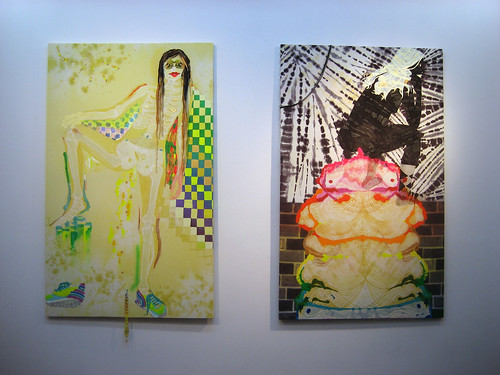
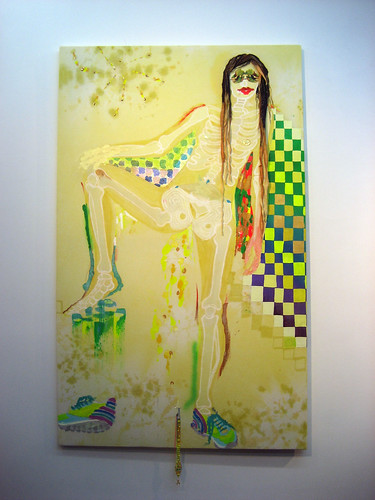
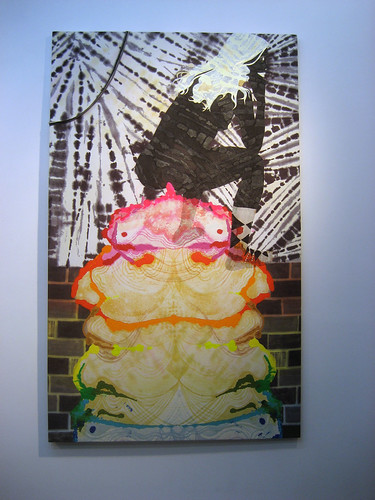
    James already wrote about her show (now closed), but I thought I would add a few of my photos.

    Frankie Martin at CANADA

    Frankie Martin at CANADA

    Frankie Martin at CANADA

    ·

    Categories:
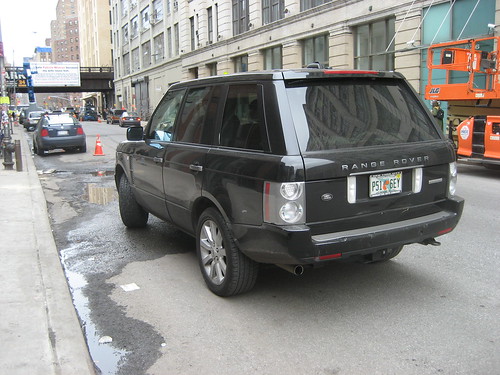
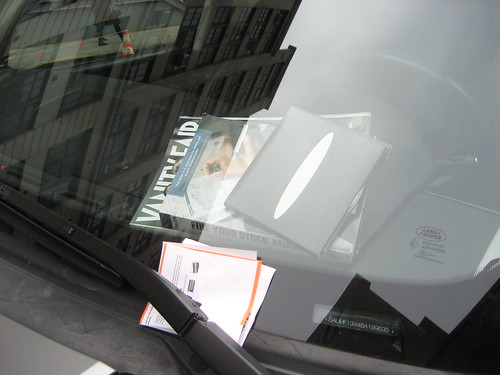
  • I’m a rich collector, I don’t have to park normally

    Spotted on 26th Street in Chelsea a week ago.

    Range Rover parked 4 feet from the curb

    On the dashboard – Fire your Stock Analyst:

    On the dash of the Range Rover parked 4 feet from the curb

    ·

    Categories:
  • Banana Republic

    I’m a few days late on this. Is it just me, or does having President Bush make a major speech related to the war in Iraq to the National Cattlemen’s Beef Association have “banana republic” written all over it?

    Related: Bush was wrong when he said that the spending bills intended to set a withdrawal date contain spending provisions not related to war and security. Of course, the media didn’t bother to report that.

    ·

    Categories: ,
  • ACT UP 20th Annivery demo tomorrow

    The message is “Healthcare for all.” See James and the Visual AIDS blog for more information.

    ·

    Categories:
  • Leaving Room for the Troublemakers

    Somewhat related to the previous post, today’s New York Times has a special section on museums. My favorite part is the essay titled Leaving Room for the Troublemakers by Holland Carter. Here are some excerpts.

    Now, as we approach the 20th anniversary of the stock-market plunge that brought the art market to its knees, money is again in truly fathomless supply. People think about it constantly, about how much there is of it, spilling out of pockets, oozing from hedge-fund accounts.

    Curators find themselves enlisted as personal shoppers to the collectors who swarm through the art fairs. Museums hope these guided purchases will end up on their walls; collectors hope they will serve as tickets to higher ground on the art-world social terrain.

    When the painter Brice Marden was interviewed in The New York Times before his recent MoMA retrospective, he talked primarily about real estate, about how many houses and how much land he had bought, or was buying thanks to his phenomenal sales. “What else am I going to do with all this money?” he asked.

    In fact, the more successful a museum grows, the more elitist it tends to become. Social distinctions based on money and patronage can assume the intricate gradings of court protocol. At street level, admission prices climb, reinforcing existing socioeconomic barriers. Programming grows more cautious. If you’re laying out $20, you want to see “the best” art, which often means art that adheres to conventional versions of beauty, authority, “genius” (white and male) set in a reassuringly familiar context.

    An extreme spin on museum populism came into vogue not too long ago, with exhibitions of “nonart” materials: motorcycles at the Guggenheim, hip-hop ephemera at the Brooklyn Museum of Art. Critics surprised themselves by raving over the Guggenheim show. Custom-made bikes, it turned out, are High Design. On the other hand, the hip-hop material, most of it mass-produced, inexpensive and readily available, was dismissed as mere merchandise. What was it doing in an art museum?

    It was illustrating, among other things, Andy WarholÂ’s canny prediction that all museums will become department stores, and vice versa. Sure enough, here we are and we have to ask the question: WhatÂ’s the difference between a top-of-the-line Harley, a Tupac poster and a Marden abstraction? Fundamentally, none. They are all brand-name items distinguished by different price tags. Populist or not, they are products of corporate marketing, of the money holders.

    One thing it can do — that museums can do — is clear an alternative space in that culture, a zone of moral inquiry, intellectual contrariness, crazy beauty. In this space, artists can simultaneously hold a magnifying glass up to something called “America” and also train a telescope on it: probe its innards and view it from afar, see it as others see it. From these perspectives, they might come up with models of a cosmopolitan, leveled-out society for a country in solidarity with the world, in contrast to the provincial, hierarchical, self-isolating one that exists today.

    The common wisdom of the moment, however, tells us that carving out such a zone is no longer possible. The market, that state of manipulated consensus called freedom of choice, is so omniscient, so all consuming, so universal that there is no alternative left, no margin; no outside, only inside.

    ·

    Categories:
  • Homeless Museum about to be homeless

    I received this letter from Filip Noterdaeme & Madame Butterfly of the Homeless Museum last week.

    HoMuLogo.jpg

    Brooklyn, March 20, 2007

    Dear friends and members of the Homeless Museum,

    Madame Butterfly and I regret to inform you that we have decided to officially close HoMu BKLYN as of today.

    As many of you know, I founded the Homeless Museum in 2003. It had its humble beginnings online and in a temporary exhibit in a painterÂ’s studio in Chelsea before I installed it in our rental apartment in Brooklyn in March 2005. I was always aware that this would be a temporary solution and am grateful for having been able to house the Museum in our home up until now. Sadly, my landlord has recently informed me that he would not tolerate any more openings on the premise unless I sign a commercial lease and carry my own liability insurance coverage, a financial burden I am not able to take on. After consulting with several lawyers, I had to resign myself to stop using my residence for openings, lest I run the risk of being evicted.

    I want to thank all of you who came and supported HoMu BKLYN in those two wonderful years. Madame Butterfly and I will miss the magic of our monthly openings. I will forever cherish the memory of welcoming and getting to know you in the coziness of our Staff and Security Department. Madame Butterfly will never again be able to cook eggs and mussels without shedding a tear. As for Florence Coyote, she has vowed to not utter a single word until a new home has been found for the Museum.

    Madame Butterfly and I are determined to continue our work as museum mavericks. HoMu BKLYN may be closed for now, but the Homeless Museum will prevail and re-emerge somewhere else. We are actively seeking to find a temporary exhibition space for its collection and welcome any help from you.

    In the meantime, we will revamp HoMuÂ’s website (homelessmuseum.org) and post a virtual tour of the historic HoMu BKLYN online. In addition, we would like to invite all of you to submit comments, anecdotes, and recollections about your experience at HoMu BKLYN for the website. Kindly send your submissions to info@homelessmuseum.org by April 30.

    Stay tuned for continued HoMu actions, performances, and exhibitions, and remember: Homelessness begins at home.

    Warm regards,

    Filip Noterdaeme & Madame Butterfly

    noterdaeme-butterfly.jpg

    Photo by Andreas Brunglinghaus

    ·

    Categories:
  • Charles LaBelle at LMCC Redhead Gallery

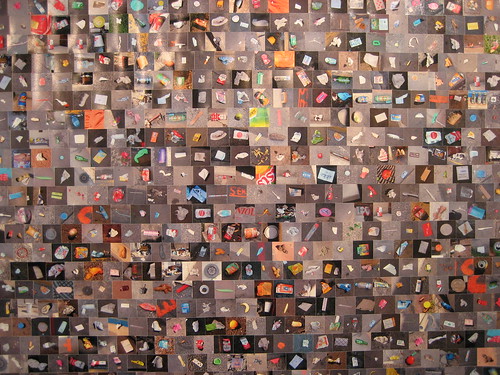
    Charles LaBelle, "Driftworks: Marseille" 2004

    Charles LaBelle, Driftworks: Marseille (detail), 2004


    This artist’s work was a new discovery for us at the LMCC Redheard Gallery’s show, Imagined Worlds. The artist creates these works, described as “compound photographs” by cutting out pieces from proof sheets to compose a new work. They’re hard to photograph, but I hope this detail gives an idea of the piece. Good stuff.

    ·

    Categories:
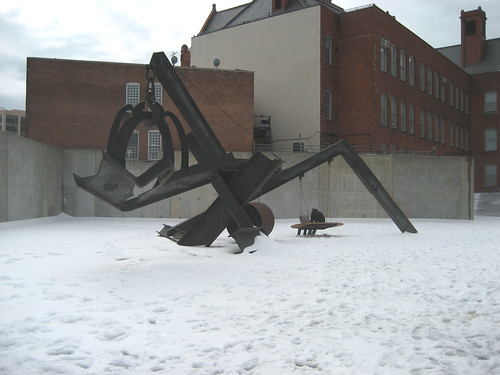
  • Mark di Suvero at PS1

    Mark di Suvero at PS1


    I snapped this a couple of weekends ago in the courtyard at PS1. Since it was outside, I could get away with taking a photo. Given the state of the sidewalks around the museum that day, I didn’t feel any guilt.

    I did find a number of shows quite interesting on our visit, including Emergency Room, Silicone Valley, and Not for Sale.

    ·

    Categories: